Overview
My research examines how firms manage and reshape interdependence in platforms and ecosystems. While prior work has emphasized loosely coupled coordination among independent firms, I view integration as a continuum that ranges from arm’s-length interactions to tightly integrated organizational forms.
I focus on how firms actively move along this continuum, through partnerships, governance choices, and acquisitions, to reconfigure ecosystem architecture. In particular, I study how these integration decisions affect interactions among complementors, the distribution of value across the system, and firms’ ability to capture that value. By linking ecosystem dynamics with corporate scope decisions, my work seeks to explain when and why firms expand their boundaries in multilateral systems, and with what consequences for competition, innovation, and user outcomes.
selected PUBLICATIONS AND WORKING PAPERS
how ecosystem structure affects firm performance following a negative shock to interdependencies
Natalie Burford, Andrew Shipilov, Nathan Furr (2022), strategic management journal, 43(1), 30-57.
This paper examines the effects of component choices on firms’ performance following a shock to the ecosystem’s alignment structure. Findings show that a reduction of local component interdependence and an increase in component dispersion across clusters has a positive effect on firm performance following a negative shock to interdependencies. Our prediction that an increased use of central components would have a negative effect was not supported, when controlling for local interdependence. This paper illustrates how graph theory concepts can be used as a tool for studying the patterns of interdependencies among components at the level of an innovation ecosystem (Shipilov & Gawer, 2020). There are multiple levels of component interdependencies in an ecosystem, and users can deploy combinations of strategies at different levels to adapt to changing conditions. When comparing the relative importance of different levels of component interdependence for firms’ performance, findings show that the impact diminishes with an increase in distance of interdependencies from the firm. The paper is co-authored with Andrew Shipilov and Nathan Furr and is published at the Strategic Management Journal.


Low Local Interdependence
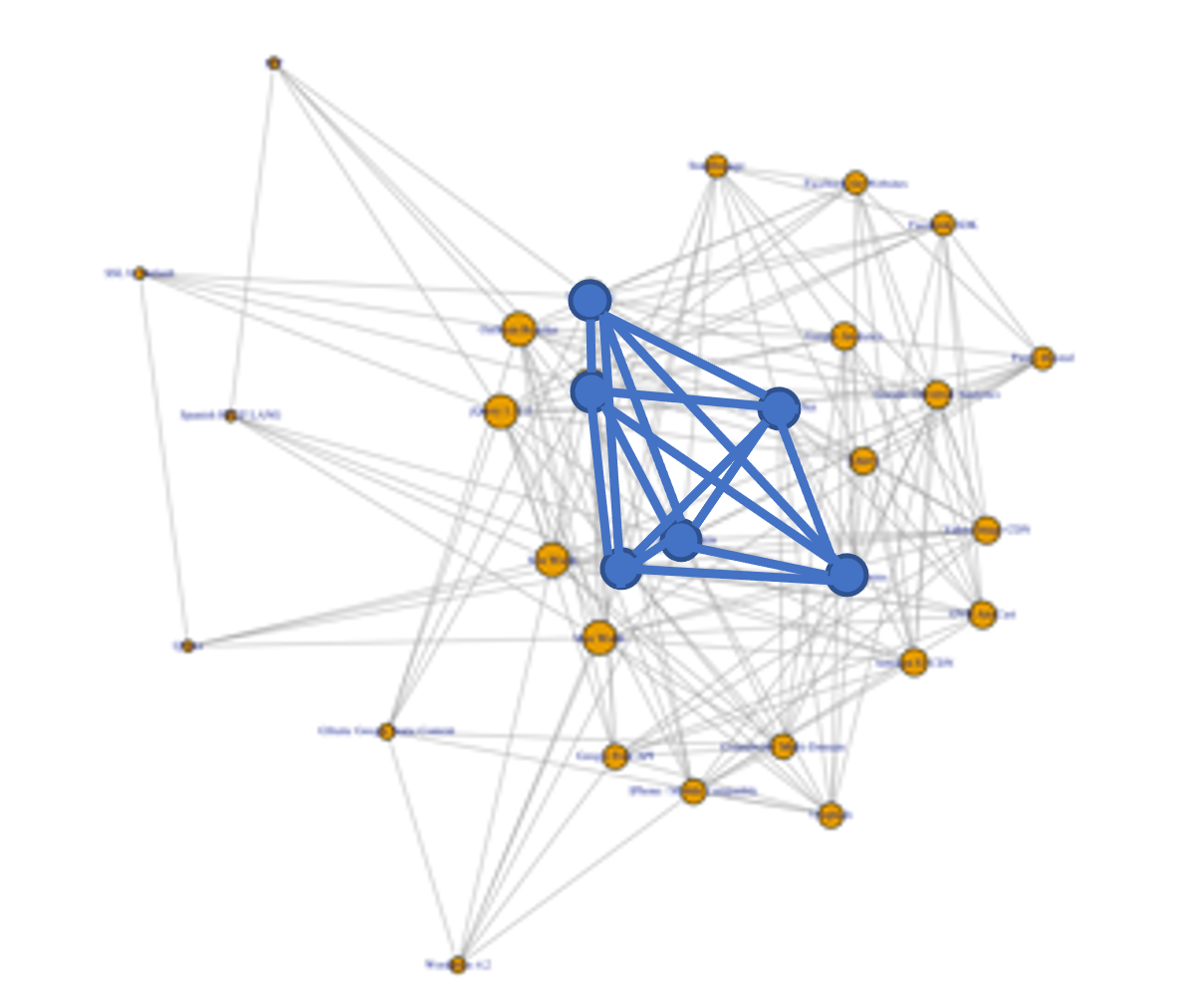
High Local Interdependence
Finding: Following a negative shock to interdependencies, firms experience a stronger negative relationship between greater local component interdependence and performance, relative to firms which do not experience the shock.
Ecosystem synergies as drivers of acquisitions
Natalie Burford, Andrew Shipilov, Nathan Furr (2025), strategic management journal, 46(13), 3218-3251.
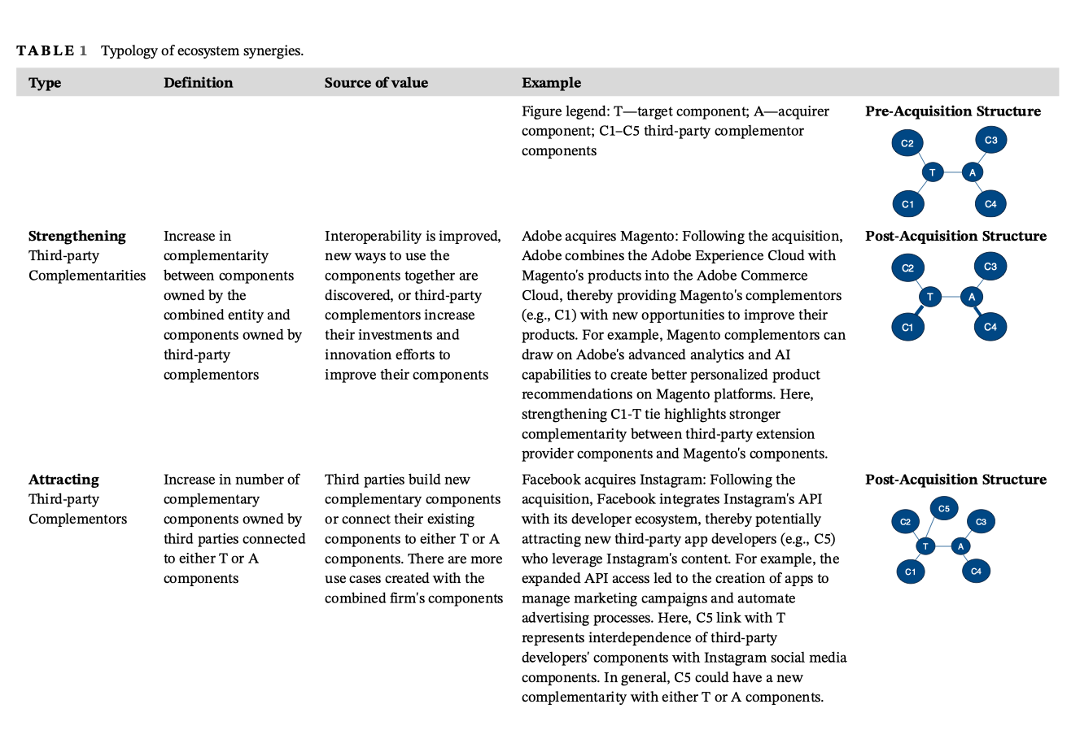
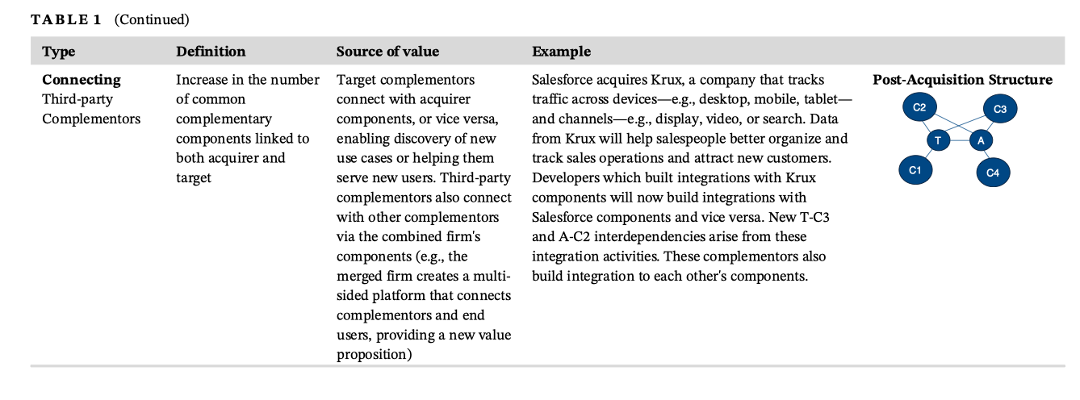
We examine how the structure of ecosystems shapes firms’ acquisition choices. We develop a theoretical framework comprising three levels of ecosystem structure – local interdependence, clusters, and centrality – that could drive choices of M&A targets based on expected ecosystem synergies, a previously undocumented acquisition synergy that creates benefits for the acquirer and the ecosystem overall. Ecosystem synergy is value created through combination of the acquirer and target's ecosystem positions that improves the combined firm's alignment with third-party complementors. Such synergies manifest themselves in increased attractiveness of the firms’ components to third parties by strengthening, attracting, or connecting complementarities. In the setting of the e-commerce technology industry, our results show that firms acquire targets to increase local interdependence of their components and their presence in component clusters.

platform expansion into customer-facing activities
Working paper
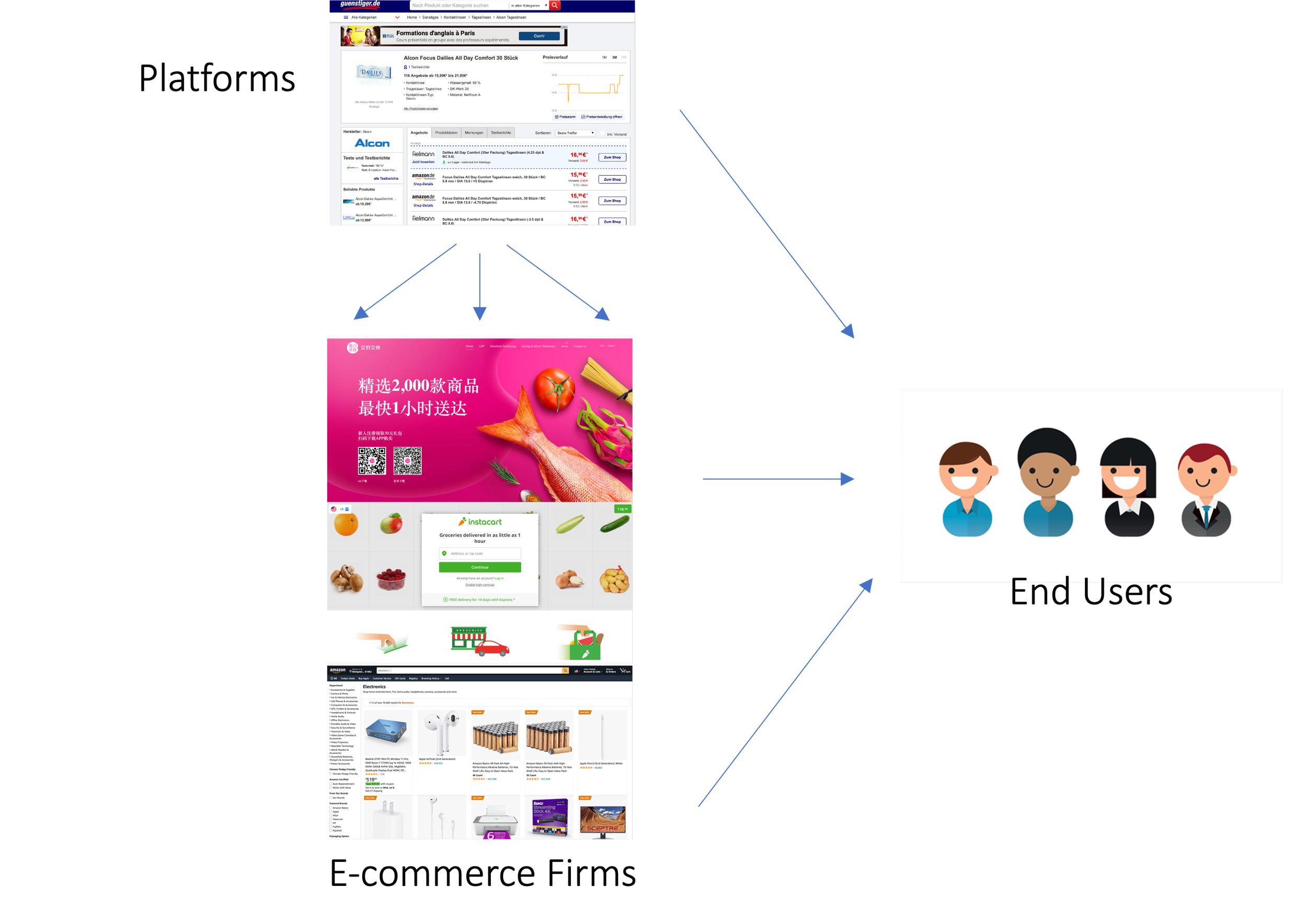
In this project, I examine the impact of platform expansion on the user engagement of unique platform participants relative to typical participants. Prior research suggests that platforms offer services and product features in order to attract new platform participants, which in turn attract more end users (Cusumano & Gawer, 2002; Parker & Van Alstyne, 2005). However, research has largely overlooked the impact of such offerings on existing platform participants. I suggest that platform owners compete with platform participants by taking over parts of their value proposition. I distinguish between platform- owner entry (Zhu, 2018; Zhu & Liu, 2018) and platform expansion into customer-facing activities. During my collaboration with a price comparison platform, I learned that the platform’s key strategic imperative is the promotion of a direct checkout feature which allows end user to pay and checkout directly on the platform instead of being redirected to the e-commerce shops that populate this platform. These shops include major e-commerce players such as Amazon and eBay. My findings suggest that the user engagement of platform participants with specialized resources and distinct ecosystem positions decreases relative to that of generalists and firms with more typical ecosystem positions, following the introduction of the direct checkout option. These results indicate that platforms’ offerings do not benefit all participants equally, and that users might engage with a more homogenous set of participants as a result of such offerings. This paper was my solo-authored job market paper and I am working on getting it ready for journal submission.